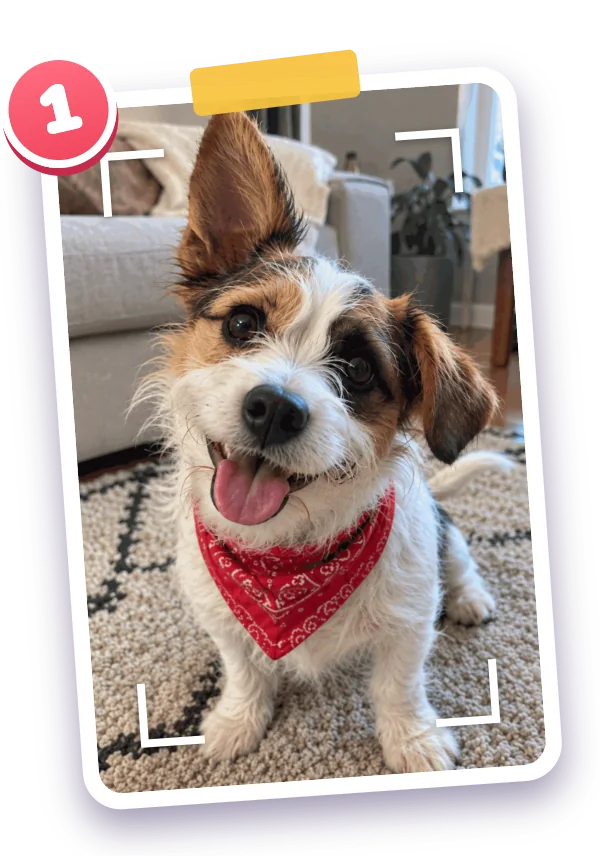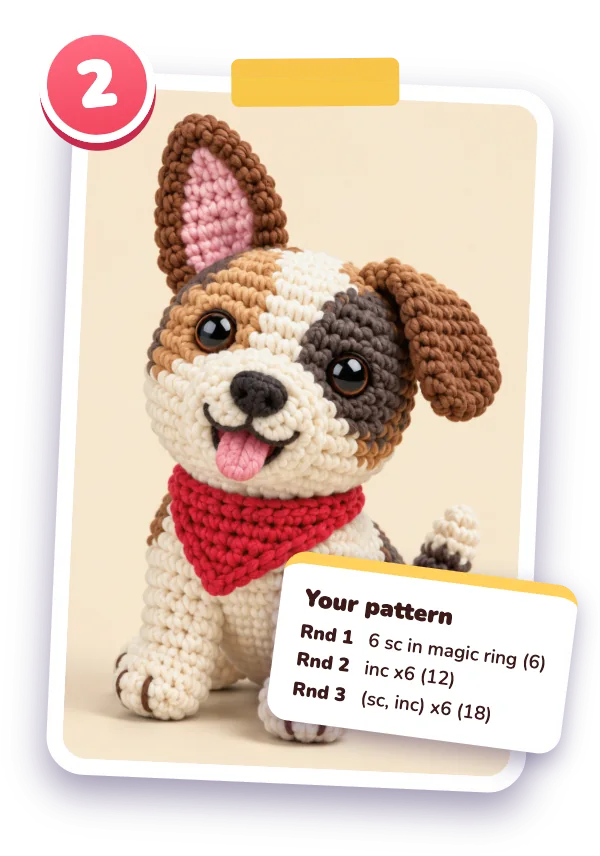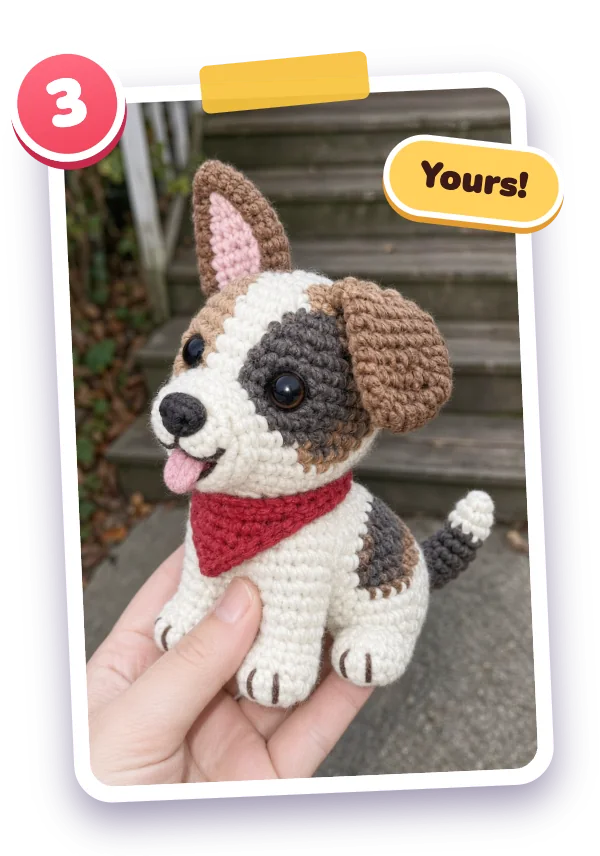

A lot of AI crochet patterns just don't work. One AI makes a picture of a toy that no one has ever crocheted, while another writes rounds that nobody has ever counted, and those two never connect. Hours later, you realize it, once the thing on your hook doesn't look at all like the thumbnail. Below is a real example, round by round, why this happens, how you can spot an AI pattern before you begin, and an AI crochet pattern generator that's different: the toy in the picture is the toy you make.
The pattern below appears as it was shared, with the maker's name removed. This is about how AI patterns go wrong, not about one shop.
Do AI crochet patterns work?
Mostly, no. A chatbot can write something that looks like a pattern, with rounds, abbreviations and a stitch count in brackets at the end of each line. But it predicts words. It doesn't count stitches, and it has never held a hook. For a flat square or a plain ball it often gets close. For a toy with a head, limbs and a face, the counts drift, the shaping goes wrong and parts of the picture are missing from the instructions.
The other side of the issue is the picture. It comes from an image model that's great at pretty and has no idea what one round of single crochet can do.
AI crochet pattern vs reality: one pattern, round by round
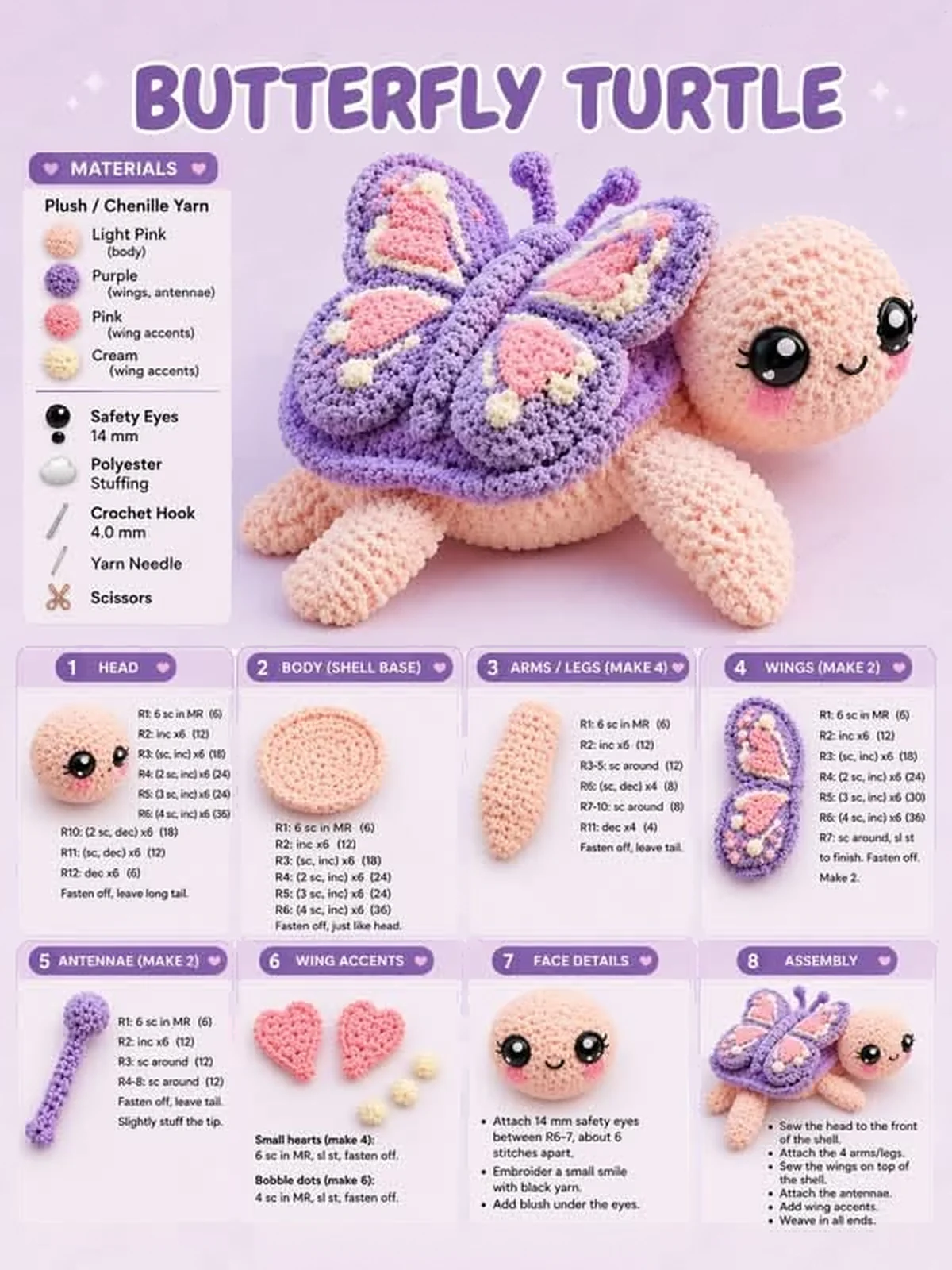
Here is a pattern that does well in a feed: a butterfly turtle. A plush peach turtle under a domed purple shell, with butterfly wings on top, pink hearts and cream trim on the wings, two antennae with a ball on each tip and big shiny eyes. It has everything a pattern should have: a materials list, eight boxes of rounds and a stitch count at the end of each line. It looks like a sweet weekend make.
Set the picture aside for now, and go by the rounds instead. The numbers shown in the picture line up with the list below it.
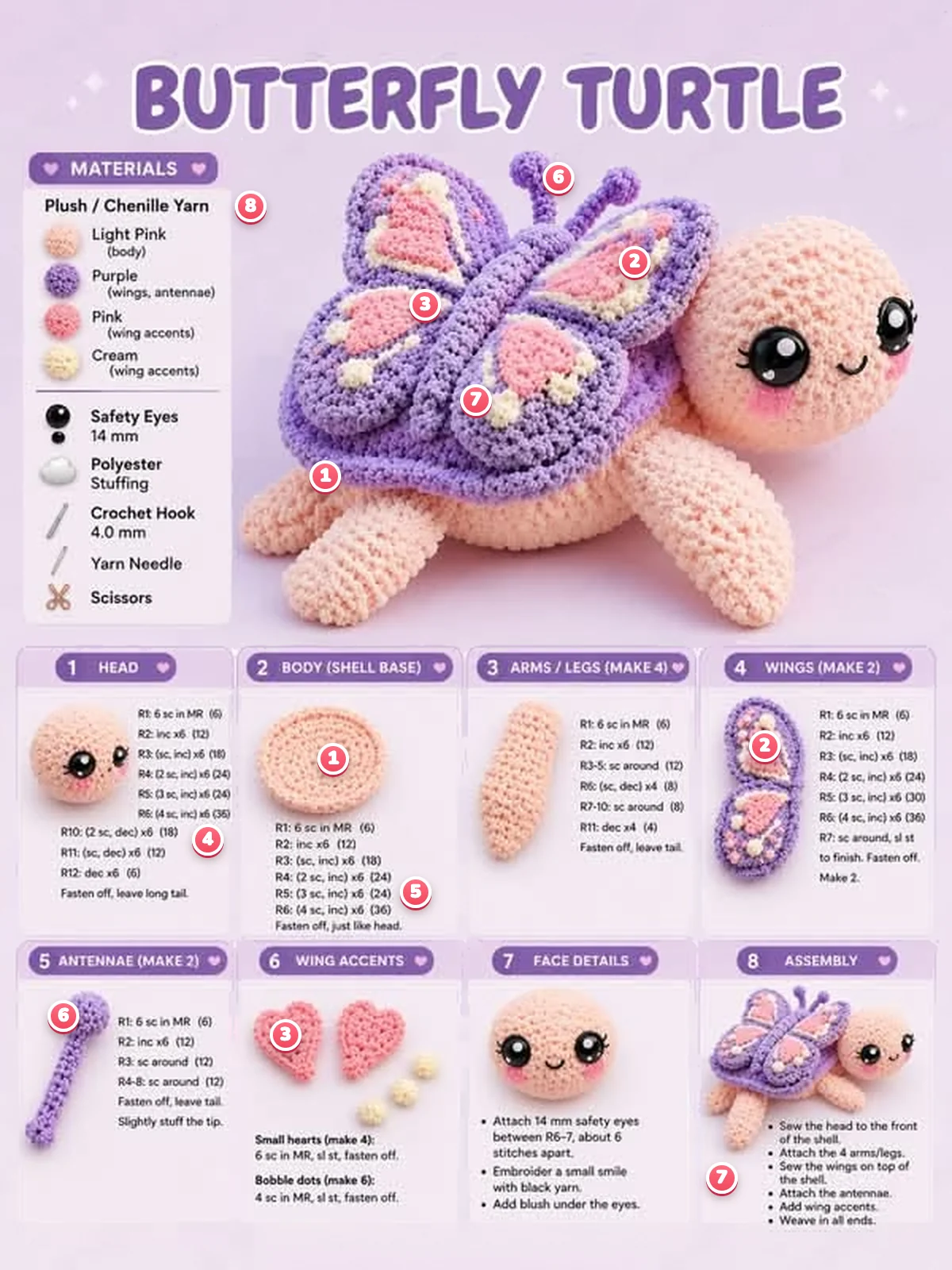
- There is no shell. There are no rounds at all in the big purple dome and its rim. The only shell mentioned is the
Body (shell base): six increase rounds, a flat circle, and thenFasten off, just like head. - The wings are two circles. Seven rounds each, six of them evenly increased: a flat purple disc. No upper and lower wing, no purple rim, no cream edge.
- The hearts are dots.
Small hearts: 6 sc in MR, sl st, fasten offmakes a little circle about half an inch (1.4 cm) across. Six stitches in a ring can't make a heart. - The head is missing rounds. Round 6 jumps right to round 10, skipping 7 through 9, the rounds that build the height of a head. And round 10 repeats over 24 stitches, but you've got 36. Once stuffed, the head balloons into a short bun that's half as tall as it is wide, not the round ball shown in the photo. The eyes land
between R6-7, beside a round that isn't there. - The counts don't add up. In the head and in the shell base,
R5: (3 sc, inc) x6 (24)makes 30 stitches, not 24, and round 6 needs those 30. - The antennae are fat tubes. Twelve stitches around for eight rounds, the same width all the way: a stub about 1.3 in (3.3 cm) thick. A thin stalk with a ball on top would need two widths.
- Nothing says where things go.
Attach the 4 arms/legs,Attach the antennae,Add wing accents: no round, no place. The butterfly's body between the wings has no pattern at all. - The yarn can't draw those lines. For this pattern, you'll need plush chenille yarn and a 4.0 mm hook. Chenille is thick and velvety, great for soft, round shapes, but way too thick for the thin cream outlines, the tiny dots, and the fine little stitches you see in the picture.
Count it up: one circle makes the body, two more circles make the wings, four tubes, two stubs, a short little head and a few dots. That's what most AI patterns boil down to. First the picture gets drawn, then rounds get written that sound like it, in the simplest shapes around.
AI crochet pattern results: what the rounds really make
We didn't guess. Every round of the pattern went into our crochet engine exactly as written, and the engine built the toy those rounds make, stitch for stitch, in the plush yarn the pattern asks for. Where the text says nothing, we did what any maker would: the head and the legs are stuffed, and each part sits where the picture has it. Nothing was added that the text has no rounds for: no shell, no hearts, no butterfly body.

It ends up roughly 3 in (8 cm) tall, and with the legs stretched out it's close to 8 in (20 cm) wide. The head is stuffed just like any crocheter would do, and it's a little round bun about 2.3 in (6 cm) wide and 1.2 in (3 cm) tall. Every wing is just a simple circle 3.3 in (8.5 cm) across, the same width as the body beneath it, and every leg is a tube about 3 in (7 cm) long.

It's still a sweet little project. It's just not the butterfly turtle you saw, and you'd learn that only after a weekend of making it.
We ran a second Pinterest pattern through the same test too, a blueberry turtle, and after that we made our own pattern that fits its photo: we tested an AI crochet pattern.
Why AI crochet patterns fail
Search for AI crochet pattern fails and you'll find the same story again and again: a gorgeous thumbnail, then a few lumps and tubes sewn together. Five things cause it.
- The picture came first, and no pattern made it. An image model drew a toy that was never crocheted: shapes no stitch count produces, details too fine for the yarn, stitches too even to be real.
- The pattern was written in one go, not counted. A line like
Rnd 4: (sc 2, inc) x6 (30)looks right and is wrong: worked over 18 stitches it makes 24. One bad count and every round after it is off. - The shapes get simpler. Rounds that nobody built come out as the plainest shapes there are: a ball, a flat circle, a tube. Everything that made the picture special is left to you, or left out.
- The yarn flatters the picture. Most AI pattern pictures are drawn as if in soft plush yarn, fuzzy and round, which makes any lump look cuddly. Plush yarn is thick, though: it can't make the thin outlines and tiny details the same pictures show.
- Nobody made it. No one crocheted it, there are no photos of the steps, and nothing checked that the picture and the pattern describe the same toy.
How to tell if a crochet pattern is AI
You can't always know, but AI crochet gives itself away. Check these before you buy a pattern or start one.
- Look hard at the picture. Too perfect is a sign: every stitch the same size, hair and fur no yarn makes, a toy lit like a magazine cover and never shown from another side.
- Look for more than one photo. A true pattern shows the toy from different angles, with pieces laid out before seaming, or partway finished. A single flawless photo and nothing more is a red flag. And a toy that looks different in each picture is one too.
- Do the math on three rounds. Each increase adds one stitch and each decrease takes one away. If the counts in brackets don't follow, stop there. Our guide to reading an amigurumi pattern shows how a round is counted.
- Match the parts to the picture. A shell, wings, hearts, a trim: everything you see should have its own instructions and a place to sew it.
- Picture the shapes the rounds make. Even increases make a flat circle, and rounds with no increases make a tube. If the pieces come down to circles, balls and tubes and the picture shows curves, points and scallops, the picture wasn't made from the pattern.
- Read the basics. Yarn weight, hook size, finished size, US or UK terms. AI patterns are often vague about all of them, or name a yarn too thick for what the picture shows.
- Check who made it. Hundreds of new patterns showing up in a shop within weeks, with no pictures from makers, is worth a closer look. And when reviews say the toy looks nothing like the photo, that seals it.
An AI crochet pattern generator where what you see is what you make
We tried most of the AI crochet pattern generators out there. Nearly all of them are the same thing underneath: a chatbot with a nice front, writing the whole pattern in one go. One shot, no check, and the pattern isn't right.
Crochet Pirate is not a chatbot with a nice front. Behind it is a crochet engine of our own, built for one job: making sure the toy in the picture is the toy the pattern makes. How it works stays in our workshop. What it does for you doesn't:
- Every round adds up. The stitch count at the end of each round is right, on every piece.
- The picture is the pattern. The toy in front of you when you begin is the one its rounds create, not a fancier relative.
- A picture at every step. Each piece and each step of sewing has its own picture to check your work against, with nothing in it that you haven't made yet.
- From a photo or a sketch. A pet, a toy, a mug, or a doodle.
Out of every generator we tested, ours is the one and only where what you see is what you make.
To see the difference side by side, look at the blueberry turtle in our AI crochet pattern test: the AI pattern's picture, what its rounds make, and the turtle our pattern makes from the same picture.
A crochet pattern from a photo or a sketch
When you look up AI crochet pattern generator from an image, you'll mostly find chart makers. Those are tools that take a picture and turn it into a grid of colored squares, good for a blanket or a wall hanging. Crochet Pirate does something else: it makes an amigurumi, a stuffed toy worked in the round, from your photo or drawing. It works best with one subject on a plain background. Here's how a photo becomes a pattern.
Is there a free AI crochet pattern generator?
Chatbots will write you a pattern for free, with the problems above. On Crochet Pirate, every pattern on this site is free, and you can follow the free ones step by step in the app. Making a pattern from your own photo is part of Crochet Pirate Pro.
Questions about AI crochet patterns
Can ChatGPT write a crochet pattern?
It can write something that reads like one. Simple flat shapes often work. For a toy, check the stitch counts round by round before you start, and expect to fix the shaping yourself: a chatbot writes words, it doesn't build the toy to see what its rounds make.
Can AI make a crochet pattern from a picture?
An image model can draw a crochet toy from a picture, and a chatbot can write rounds for it, but the two aren't connected. Crochet Pirate connects them: the pattern made from your photo and the pictures you follow are one and the same toy.
Are Crochet Pirate patterns made with AI?
AI plays a role, sure, but it's not the piece we rely on. Before anything reaches you, each pattern runs through our own crochet engine, and the photos you work from are made from that pattern. The rest stays our secret.
How do I know an AI crochet pattern will work before I start?
Count the first few rounds, picture the shapes the rounds make, look for photos of the steps and the pieces, and match every part in the picture to the instructions. If any of these doesn't hold, pick another pattern.
Is there an app for making crochet patterns?
Yep. Crochet Pirate runs right in your browser, whether you're on a phone or a computer. You go through a pattern round by round, and each checkpoint has a picture, plus a counter that holds your spot.
Free patterns to try
Each one is written round by round, with a stitch count for every round:
- Rogue goat crochet pattern (Intermediate)
- Highland cow crochet pattern (Advanced)
- Dragon crochet pattern (Advanced)
- Frog crochet pattern (Easy)